Social media drives Black Friday sales: The first stats are in
Black Friday 2025 marks social commerce's breakthrough moment. With sales up 54.5% and household names like Samsung and Disney joining TikTok Shop, the data is clear: Social platforms have evolved from inspiration channels into revenue drivers.
December 1, 2025

Black Friday 2025 has proven that social commerce is no longer just a buzzword – it’s a genuine revenue driver that’s reshaping how consumers shop during the biggest retail event of the year.
Social commerce sees record growth
This year’s Black Friday saw social media platforms generate 3.4% of all online sales (Adobe Analytics, 2025), marking a significant 54.5% year-over-year increase. While that percentage might seem modest, it represents a fundamental shift in shopping behavior, especially when compared to the flat growth social platforms experienced in 2024.
The acceleration isn’t accidental. Social platforms have evolved from inspiration channels into full shopping destinations, with native checkout features, live shopping events, and creator storefronts removing friction from the purchase journey. What used to require multiple steps – seeing a product on Instagram, searching for it on Google, then buying on a brand’s website – now happens in a single tap.
The real story lies in the influence layer: affiliates and social media influencers drove 21.9% of Black Friday revenue (Adobe Analytics, 2025), up from 19.6% last year. Even more striking, influencer and affiliate marketing converts shoppers at six times the rate of standard social media campaigns (Hostinger, 2025).
This performance gap highlights a crucial insight: consumers don’t want to be sold to – they want recommendations from voices they trust. Creators have built genuine relationships with their audiences, and those parasocial bonds translate into purchasing power. When a trusted creator recommends a Black Friday deal, it carries more weight than any branded advertisement.
Platform wars: Gen Z vs. Millennials
The data reveals a clear generational divide in platform preference. TikTok Shop has captured 40% of Gen Z shoppers, while Facebook remains the go-to for 53% of Millennials (Hostinger, 2025). Retailers leveraging multi-platform social commerce strategies reported that 19% of their total sales came through channels like TikTok Shop and Instagram (Queue-it, 2025).
This split reflects more than just age – it’s about how different generations discover and evaluate products. Gen Z has grown up with seamless in-app shopping and trusts the algorithm to surface relevant products through their feed. Millennials, meanwhile, rely on their established social networks and communities for recommendations, making Facebook’s social proof mechanisms particularly effective.
TikTok Shop’s maturation is visible in its brand roster. Major household names including Samsung, Disney, Ralph Lauren, Crocs, Fenty Beauty, and Estée Lauder joined the platform for Black Friday 2025, signaling a watershed moment for social commerce legitimacy.
In 2024, one creator, Stormi Steele of Canvas Beauty Brand, even surpassed $2 million in sales during a single Black Friday livestream (TikTok, 2025) – demonstrating the platform’s potential for direct creator-to-consumer sales at scale.
“Social proof has become the new shop window,” notes one industry analyst. The numbers back this up: 64% of Black Friday shoppers say customer reviews on social media influence their purchasing decisions (DHL eCommerce, 2025).
The bigger picture
Black Friday 2025 shattered records with $11.8 billion in U.S. online spending (Adobe Analytics, 2025), up from $10.8 billion in 2024. Social commerce’s accelerated growth comes as mobile devices continue to dominate, accounting for the majority of online purchases.
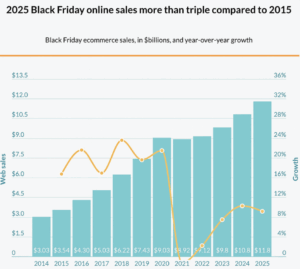
Chart: Digital Commerce 360
Another factor reshaping the landscape: AI-driven shopping. Traffic to retail sites from AI sources like ChatGPT and Perplexity surged 805% year-over-year on Black Friday (Adobe Analytics, 2025). More significantly, shoppers who used generative AI services to reach product pages were 38% more likely to complete their purchase (Adobe Analytics, 2025). The intersection of AI discovery and social commerce represents a fundamental shift in how consumers find and buy products.
The trust factor plays a crucial role, particularly among younger shoppers. 56% of Gen Z consumers trust retailers’ Black Friday pricing, compared to just 38% of Baby Boomers (DHL eCommerce, 2025) – a demographic insight that explains why social commerce, with its peer-review culture and creator authenticity, resonates so strongly with younger audiences.
Gen Z’s higher trust isn’t naive optimism – it’s a different model of verification. Rather than trusting traditional advertising, they trust the collective intelligence of their social feeds. They see what real people are buying, read comments from actual customers, and watch unboxing videos before making decisions. Social commerce succeeds because it’s built on this distributed trust model.
Planning the next big moment in commerce
As social platforms evolve into legitimate shopping destinations, brands can no longer treat social media as purely a top-of-funnel awareness channel. The data from Black Friday 2025 confirms that social commerce has matured into a full-funnel revenue driver, with Gen Z leading the charge and other demographics following close behind.
For marketers planning their 2026 strategies, the message is clear: invest in creator partnerships, optimize for platform-specific shopping features, and build authentic social proof – because that’s where your customers are increasingly choosing to shop.
We make advertising meaningful.