Why BYD's home market slowdown matters for marketers in 2027
While China's largest EV maker sees its home sales drop 33% and its international sales climb 86%, the underlying story is not automotive. It is a marketing lesson for every consumer brand planning 2027 across shifting global markets.
September 8, 2026
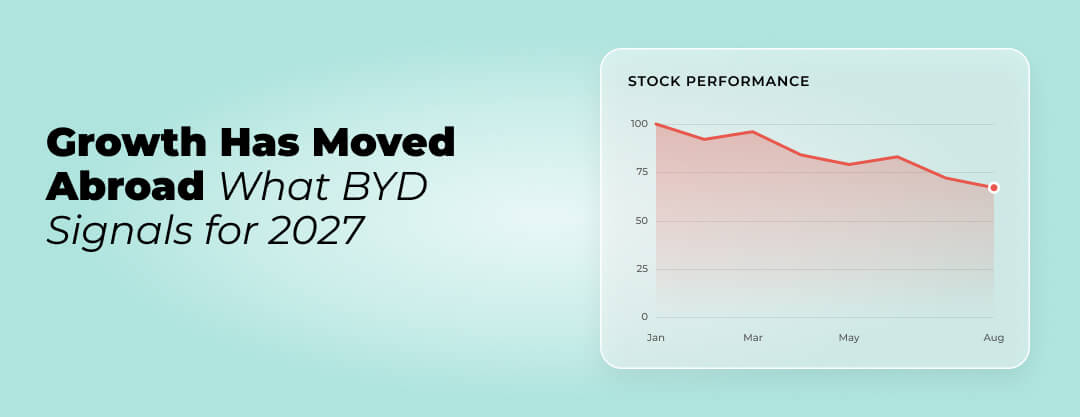
Chinese EV giant BYD published a set of numbers this week that read like two different companies. In the first eight months of 2026, domestic sales fell 32.72% to 1.5 million vehicles, while international sales surged 85.72% to 1.16 million. August alone set a record at 189,466 units sold abroad. The company revised its 2026 export forecast up from 1.5 million to 2 million vehicles, and for the first time announced a 2027 target of more than 2.5 million international sales.
BYD is running one of the largest live case studies of a consumer brand pivoting its growth engine from its home market to the rest of the world. The playbook, the constraints, and the outcomes are visible in real time. And the lessons apply to any consumer brand planning 2027 across regions where the home market has flattened or reversed.
The home market is no longer where growth happens
For decades, most consumer brands built their marketing operating model around the home market. Headquarters set strategy, home teams executed at scale, international expansion followed as a secondary priority. That structure worked because home markets grew.
BYD’s numbers are one signal among many that this era is ending for several categories. Chinese consumer electronics, European luxury, American fast food, Japanese automotive, and many other traditionally home-dominant categories are seeing their growth engines shift abroad while home markets flatten or slow down.
The marketing implication is that international teams are no longer the extension of the home team. They are the growth engine. That reversal changes how brands should allocate creative resources, media investment, and senior attention. It also changes how brands should think about influencer marketing, which historically has been treated as a home-market discipline that gets translated into local markets.
Translation is not localization
BYD’s international sales are growing fastest in Southeast Asia, Latin America, the Middle East, and select European markets. Each of these regions has a completely different consumer relationship with electric vehicles, with Chinese brands, and with the concept of premium mobility itself.
The temptation for global brands entering new markets is to take existing content from the home market, translate it, and push it into local platforms. This approach fails predictably because translation captures words, not context.
In Europe, where BYD faces tariff pressure and skepticism about Chinese quality standards, the marketing challenge is neither education nor legitimacy but perception, and it requires creators whose audiences already trust them on premium consumer purchases.
Speed becomes the differentiator
BYD went from a Chinese domestic player to a global exporter selling 189,000 vehicles in a single month in less than five years. That speed of expansion is possible when the operational infrastructure scales without waiting for full localization at every step.
The marketing equivalent is having a system that can activate in a new market within weeks, not quarters. This requires three capabilities most brands underinvest in.
First, a creator identification and vetting infrastructure that works in every market where the brand plans to enter. Building this network from scratch when a new market opens loses six to nine months.
Second, a briefing and approval system that respects local nuance while maintaining brand consistency. Central control that requires every piece of content to route through headquarters kills speed. Complete local autonomy without brand guardrails produces inconsistent output. The balance is a shared framework with clear escalation thresholds.
Third, a measurement system that tracks the same KPIs across markets. Without this, comparing performance across regions becomes guesswork, and reallocating budget toward markets that outperform becomes political rather than data-driven.
Brands that have these three capabilities in place before they need them capture international opportunities faster than competitors who build them reactively.
What this means for 2027 planning
If your 2027 growth plan depends on international markets, the BYD story is worth reading not as an automotive news item but as an operational preview of the environment you are planning into.
Consumer brands running multi-country campaigns typically hit the same problem. Strategy comes from headquarters. Execution is subcontracted market by market, often to a different agency in each country. Measurement gets aggregated at the end, using inconsistent KPIs and reporting formats that make cross-market comparison guesswork rather than analysis.
That model was tolerable when international was the secondary line and home markets carried the plan. When international becomes the growth engine, the fragmented model starts costing brands real performance. Speed of activation slows. Creative consistency breaks. Budget reallocation between markets becomes political because the data does not compare cleanly.
The alternative is consolidating strategy, execution, and reporting under one global operating partner. Not one agency doing everything
in every market, but one accountable partner running a coherent system across all markets: shared briefing frameworks, consistent KPI definitions, unified reporting, and local teams that operate against the same playbook.
This is the operational lesson from BYD, and it applies well beyond automotive. When international carries the growth, the operating model has to change. Brands that make this shift in their 2027 planning enter next year with structural advantage over competitors still stitching together local execution one country at a time.
BYD’s numbers make the case concrete. A Chinese EV brand losing a third of its home sales while nearly doubling its international sales is not just a business story. It is a signal that global operating infrastructure is now a competitive differentiator, and the brands that build it earlier win the markets it opens.
For a broader read on what worked in consumer marketing in 2026 so far, see our review of the top 5 marketing campaigns of the first half of the year.