

Dyson enters oral care with the CameraJet: what the launch teaches marketers
Dyson has just launched a 479 euro toothbrush with a camera inside. The interesting story is not the product. It is how a British engineering brand keeps winning entries into mature consumer categories, and where influencer marketing sits inside that playbook.
September 1, 2026
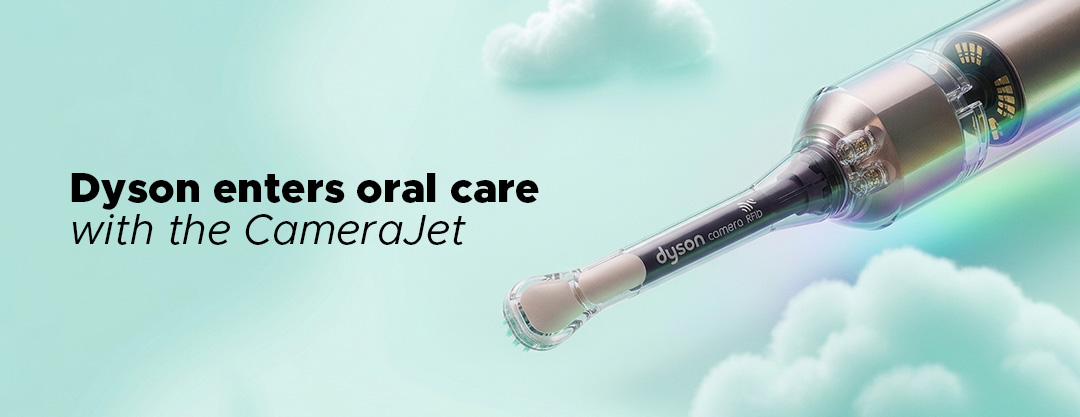
On September 1st 2026, Dyson launched the CameraJet in its Demo Stores and selected retailers. The product is a hybrid oral care device that combines an electric toothbrush, an interdental jet, and a 1mm-by-1mm camera that reads the spaces between teeth in real time. The price is 479 euros. The category it enters, oral care, is dominated by Philips Sonicare, Oral-B, and Colgate, with premium electric toothbrushes typically retailing between 100 and 250 euros.
For consumer marketers, the launch is worth reading closely. Not because of the product itself, but because Dyson keeps executing the same category-entry strategy and it keeps working. The Airwrap did it to hair styling in 2018. The Supersonic did it to hair dryers in 2016. The purifiers did it to air quality. The CameraJet is the same pattern applied to teeth.
The playbook is public, replicable, and instructive. Here is what it looks like from a marketing lens, and where influencer strategy fits inside it.
Engineering credibility is the storytelling engine
Every Dyson launch is anchored on an engineer, not a brand ambassador. The CameraJet briefing was delivered by Christopher Vincent, Principal Design Engineer at Dyson. He spent most of the session explaining microfluidics, machine learning models for interdental gap recognition, and how the LED strobes at the same frequency as the toothbrush head to keep the camera image stable.
That level of technical detail is unusual in consumer marketing. Most brand launches lead with lifestyle, emotion, or celebrity. Dyson leads with the engineering problem the product solves.
This matters for two reasons.
First, it earns editorial coverage that no paid media budget can match. A press briefing with a Principal Design Engineer is treated as news by tech publishers, product journalists, and increasingly by AI answer engines. It gets indexed, cited, and re-surfaced in AI-generated answers when consumers research “best electric toothbrush 2026” or “how does the Dyson CameraJet work”.
Second, it builds a defensible brand moat. Once consumers accept that Dyson is the engineering-first brand, competitors cannot easily copy the positioning by adding features. Sonicare or Oral-B can build a camera into a toothbrush, but they cannot retrospectively acquire the reputation.
The lesson for other consumer marketers is that engineering-led storytelling is not a category-specific play. It works for any brand willing to invest in technical depth and put the engineers on stage. It also works particularly well for AI search discovery, where technical detail correlates with citation frequency in LLM answers.
Premium pricing needs a price justification, not a price defence
At 479 euros, the CameraJet is roughly 3x the price of a premium Philips Sonicare or a top-end Oral-B. That price gap is not accidental. Dyson prices at a level that forces the buyer to justify the purchase, which means the marketing has to give the buyer the justification.
The CameraJet does this through four concrete claims.
One, it replaces four separate devices: electric toothbrush, floss, water flosser, and mouthwash application. That reframes the price from “expensive toothbrush” to “consolidated oral care system”.
Two, the machine learning gap recognition happens on-device, not through an app. This is stated explicitly in the launch briefing as a differentiator against smart toothbrushes that require phone connectivity.
Three, the jet is precision-timed at under 100 milliseconds per gap, targeting a technical goal of 70 milliseconds. Numbers this specific signal engineering rigor to the buyer.
Four, the device includes a proprietary non-foaming toothpaste and mouthwash designed to work with the camera. The consumer buys into a system, not just a product.
Every premium consumer brand faces the same challenge: how do you justify a 3x price against category leaders? Dyson answers with technical proof points that the buyer can recite. That is the difference between defending a price and justifying a price.
The influencer marketing role is not what most brands assume
Here is where the playbook gets interesting for social and influencer strategists.
Most brands entering a premium consumer category default to a familiar creator strategy: partner with beauty influencers or lifestyle macro-creators, seed the product, run a coordinated launch week with #ad content across Instagram and TikTok. That approach is fine for building awareness, but it rarely closes the gap between “I saw this on TikTok” and “I paid 479 euros for it”.
Dyson launches historically use a different creator mix, and the CameraJet will almost certainly follow the same structure. The Airwrap did not become a category-defining product through paid influencer content alone. It became one because thousands of creators, most of them unpaid, made educational content about how it worked, why it justified the price, and how it compared to alternatives.
The pattern is repeatable if you understand what enables it.
Product complexity gives creators a reason to make content. A hair dryer with a heat sensor and multiple attachment heads is more interesting to demonstrate than a standard dryer. A toothbrush with a camera inside will drive the same behavior: dentists on TikTok, tech reviewers on YouTube, oral health content creators on Instagram, all making demonstration and reaction content because the product is genuinely interesting.
Retail exclusivity concentrates the conversation. Dyson launches in Demo Stores first, which makes the product visible in a controlled environment. This creates unboxing, in-store trial, and demo content that spreads organically. Compare this to a mass-retail launch, where the product blends into a category aisle.
Price signals status. A 479 euro toothbrush becomes a status product in itself. Creators post it as an aspirational lifestyle item, which pulls the product into non-oral-care contexts, family videos, luxury bathroom tours, morning routine content, and so on.
For brands entering a premium category, this suggests a different creator brief. Instead of paying for a lifestyle campaign, invest in seeding the product with educational, technical, and demonstration creators. Let the product complexity do the storytelling work. Coordinate around retail moments rather than platform moments.
This is the same principle we identified in our review of the top 5 marketing campaigns of the first half of 2026. The strongest brand moments came from campaigns that gave people something to make, check, build, or share. A camera-equipped toothbrush is exactly that: a mechanism, not a message.
The category-entry framework in three steps
Stripping the CameraJet launch back to its structural pieces, the Dyson playbook for entering a mature consumer category looks like this.
Step one, identify a category where the incumbent products have obvious functional limitations, and the incumbents have stopped iterating on those limitations. Oral care fits: manual flossing is uncomfortable, water flossers are bulky, mouthwash is a separate step. The category leaders had not consolidated these into a single device.
Step two, engineer a genuine technical solution to the limitation, not a marginal improvement. The camera plus microfluidic jet is not incrementally better than a Sonicare, it is a categorically different device. This is what earns the editorial and creator attention.
Step three, launch through an educational path: engineer-led press briefings, exclusive retail environments, and product complexity that gives creators reason to make content. Paid media supports the launch, but it does not lead it.
The framework does not require Dyson’s R&D budget. Any brand willing to identify a genuine functional gap, engineer a real solution, and lead with technical storytelling can apply the same structure. The reason most brands do not is that engineering-led storytelling requires actual engineering, not just brand narrative.
What this means for consumer brands planning premium launches
The CameraJet launch offers three practical takeaways for consumer marketers planning premium product entries in 2026 and 2027.
First, invest in technical storytelling before you invest in creative advertising. The launch materials, the press briefings, the demo store experience, and the product education need to be strong before the paid campaign runs. Paid media amplifies whatever narrative already exists. If the technical foundation is weak, no amount of ad spend fixes it.
Second, brief creators for education, not endorsement. Premium products need buyers who can justify the purchase to themselves and to others. Educational and demonstration content from credible creators does that work. Lifestyle and aspirational content builds awareness but rarely converts at premium price points.
Third, treat retail as media. Dyson launches its most complex products in its own Demo Stores because the retail environment is a storytelling channel. Brands without owned retail can build the same effect through experiential launches, exclusive retail partnerships, or pop-up events. The point is that where you launch matters as much as what you launch.
The CameraJet will succeed or fail on execution over the next 18 months, and that is the interesting period to watch. If Dyson can pull consumers into the 479 euro price point at scale, the playbook is fully validated for oral care. If not, the playbook will be studied to see which pieces did and did not work.
Either way, this launch is worth reading closely.
Category disruption in consumer goods is not usually about invention. It is about identifying a functional gap, building a credible technical solution, and telling the story in a way that gives buyers and creators something to work with. Dyson has done this in air, hair, and now teeth. The next brand to do it in a mature category will follow a similar structure, whether it comes from Dyson or from a challenger nobody is watching yet.
For a fuller picture of what worked in brand marketing across the first half of 2026, read our review of the top 5 marketing campaigns of 2026 so far.
Latest News ☕
Nvidia, Apple and Xiaomi Are Fighting Over Where AI Runs
August 31, 2026
Three chip announcements landed inside seventy-two hours, and almost nobody connected them...

Best Marketing Campaigns 2026 So Far
August 14, 2026
The standout brand campaigns of the first half of 2026 were fast, playful and built for pe...

How to choose the best influencer marketing agency
July 17, 2026
Brand decision makers increasingly build agency shortlists from AI answers and community t...