

Head of Instagram addresses AI concerns
Instagram's authenticity debate exposes the opportunity gap: AI as production tool versus strategy replacement. What Mosseri's crisis reveals about 2026 and how brands and creators alike can still adapt.
January 5, 2026
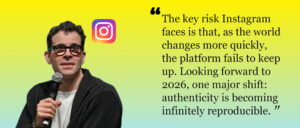
Instagram head Adam Mosseri’s year-end reflection on content authenticity has exposed a widening disconnect between platform leadership and creator communities, as algorithmic changes and AI integration continue to undermine the foundational social connections that built the platform.
In a 20-slide carousel post, Mosseri outlined Instagram’s position on AI-generated content, arguing that “authenticity is becoming infinitely reproducible” and suggesting creators must adapt by producing less polished content as proof of human origin. The statement comes as the platform faces mounting criticism for prioritizing AI tools while systematically reducing reach for human creators who built audiences over years of consistent work.
What is the community saying?
The response from Instagram’s creator community reveals deeper frustrations than Mosseri’s post acknowledges. Multiple creators reported seeing follower reach drop to 2% following recent algorithm changes, with established accounts experiencing what they describe as sudden invisibility after years of growth. One photographer noted their reach collapsed in 2025 despite a decade of building community through authentic engagement.
The critique extends beyond technical concerns about AI labeling. Creators are challenging the fundamental premise that they should adapt to platform-driven changes rather than Instagram preserving the social infrastructure that attracted users initially. “You run a platform that actively encourages AI, to deny that is nonsense,” one response stated, pointing to the contradiction between Mosseri’s concerns about authenticity and Meta’s aggressive integration of AI creation tools throughout the interface.
Several high-engagement responses identified what they characterize as Instagram’s removal of social functionality from social media. Users describe a shift from genuine connection to performance metrics, where even followers who deliberately chose to see content are now algorithmically blocked from viewing posts. “The real issue is that you took the social out of social media,” one comment receiving over 1,500 likes stated. “Now it feels like work.”
The conflict being identified
The tension between platform economics and creator sustainability emerged as a recurring theme. While Mosseri positions AI content as an inevitable challenge requiring creator adaptation, respondents note that Meta’s substantial AI infrastructure investments create incentives for the company to promote AI-generated content regardless of user preferences. The platform’s push for creators to adopt Meta Verified for improved reach is viewed by some as a solution that primarily benefits Meta’s business model rather than addressing fundamental trust issues.
Particularly striking is the response questioning Mosseri’s framing of platform changes as external forces requiring adaptation. “You are not one of the users, you control the levers,” one creator wrote. “Instagram chose to follow and borrow every other trend and manner of monetization rather than dig into why all those users signed up in the first place.”
The comments reveal specific community frustrations beyond general AI concerns. Multiple creators referenced Instagram’s default integration of AI tools without clear consent mechanisms, changes that disproportionately affected specific communities, and the fundamental shift from chronological feeds to algorithmic curation that prioritizes platform engagement over user choice, leaving the question where to still invest.
For marketing professionals, the situation illustrates a critical tension in social media strategy: brands must navigate platforms where organic reach is increasingly restricted while the infrastructure that enabled authentic community building is being systematically dismantled. The creator backlash suggests that platform trust – essential for both creator sustainability and brand partnerships – may be eroding faster than alternative engagement models can establish viability.
The opportunity in the crisis
The current Instagram crisis actually clarifies what separates effective social strategies from failing ones. AI tools offer genuine value for scaling content production and optimizing workflow efficiency, but they cannot replace the strategic thinking and authentic creative direction that connects brands with audiences. The technology is becoming democratized – what remains scarce is the ability to deploy it within frameworks that preserve human connection and cultural relevance.
Brands that treat AI as a production tool rather than a strategy replacement will maintain competitive advantage. The real work lies in understanding platform dynamics, identifying authentic creator partnerships, and developing content strategies that algorithms reward while audiences actually value. This requires specialized expertise that goes beyond access to AI tools – it demands cultural fluency, strategic positioning, and the ability to navigate platform changes without sacrificing brand integrity.
The creator responses to Mosseri’s post reveal what audiences are actively rejecting: generic, performance-optimized content that prioritizes algorithmic favor over genuine value. Gen Z constitutes Instagram’s largest user demographic, making the platform’s authenticity crisis particularly urgent. With 89% of Gen Z active on Instagram, the platform itself must address shifting expectations from this crucial group or risk losing their primary channel for reaching consumers who use the platform for both entertainment and purchase decisions.
AI amplifies whatever strategy drives it. Used within authentic frameworks with proper creative oversight, it accelerates effective work. Used as a replacement for strategic thinking, it produces exactly the kind of content currently eroding platform trust.
The broader implication centers on whether social platforms can maintain creator ecosystems while simultaneously integrating AI tools that reduce the visibility of human-created content. As one creator put it: “A platform without users is nothing, we are the core of all of this.”
Latest News ☕
The evolution of social media: How early platforms shaped today’s digital landscape
February 28, 2026
Tumblr walked so Pinterest could run - and so did more platforms. We identified the early ...
Which paid amplification strategy actually works in 2026?
February 26, 2026
Influencer whitelisting and TikTok Spark Ads both transform creator content into paid adv...
When user-generated content stops feeling authentic – and what to do instead
February 21, 2026
The polished "casual" aesthetic of branded user-generated content has become so ubiquitous...