How McDonald’s turned F1 track corners into a sales channel
The Golden Zone is the campaign in which McDonald’s, official regional sponsor of Formula 1 in Latin America, turned F1 track corners into live offers inside its app. It won Lions at Cannes 2026 and, according to reported results, drove a 7% lift in daily sales on race days.
November 11, 2026
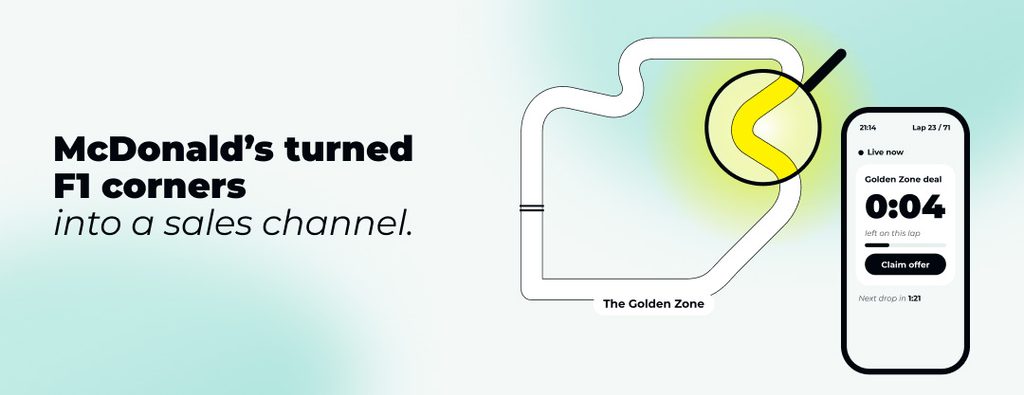
The idea starts from a simple observation: every circuit on the calendar has a sequence of corners that traces the “M” of the Golden Arches. The logo was already on the track. It just had to be found.
One correction to how the case is circulating on social media: McDonald’s did not enter F1 “without sponsoring”. It is the official regional sponsor for Latin America. What is new is how it activated that sponsorship: no logo on a car, but inside fans’ smartphones.
How The Golden Zone works
The team behind the campaign analysed all 24 circuits on the 2025–2026 F1 calendar and, for each one, identified the section that most closely follows the shape of the Golden Arches. That section became the “Golden Zone” for that race.
The mechanic, during the Grand Prix:
- McDonald’s tracks the race leader’s position in real time.
- When the leader enters the Golden Zone, an exclusive offer appears in the app.
- The offer stays live only for the seconds it takes the car to cross the zone, then disappears.
- Every lap starts again: fans who know the track can anticipate the next “drop”.
Each circuit has its own “M” shape, which becomes that race’s visual identity: in-app graphics, social content and dedicated merchandise. The campaign launched at Interlagos for the 2025 Brazilian Grand Prix, with activations across races in Brazil, Argentina, Mexico, Colombia and Peru.
The results
The available figures were reported by the trade press: read them as campaign-reported data, not independent measurement.
| Metric | Result |
|---|---|
| Daily sales on race days | +7% incremental, concentrated in the 2 hours of the Grand Prix |
| McDonald’s app downloads | 2.7 million in November 2025, +42% vs the same period a year earlier |
| Active users during races | 2.3 million |
| Cannes Lions 2026 | Silver Lion and Bronze Lions |
| Effie Latam 2026 | Finalist, as a multi-market case across Colombia, Brazil and Argentina |
After seven Grands Prix across 2025 and 2026, the platform is expanding to more markets and races this season.
Why it works: from visibility to action
Classic sports sponsorship buys visibility: a logo on the car, the helmet, the hospitality suite. The audience receives it passively. The Golden Zone moves the brand from the TV screen to the fan’s smartphone, giving them a reason to open the app on every lap.
Three choices make the mechanic strong:
- An asset the brand already owns. The shape of the logo existed on every track. No competitor can copy the idea without copying the trademark.
- The race rhythm as the trigger. The offer follows the leader, so sporting tension and commercial tension coincide. Every lap is a new “drop”.
- Real scarcity. Offers last a few seconds: the second screen becomes a game, not a notification to ignore.
This was the project’s stated goal: turning passive viewing into active participation, with repeat purchases in the app.
Part of a bigger pattern: the most innovative campaigns of 2026
The Golden Zone is not an isolated stunt. It follows the same logic as the campaigns that defined 2026, which we cover in our best marketing campaigns of 2026 so far:
- Uber Eats, “Build Your Own Super Bowl Commercial”. Fans assembled their own ad inside the app and unlocked a Game Day deal. Like The Golden Zone, it put the sporting moment and the purchase in the same place, and it delivered Uber Eats’ best-ever Super Bowl sales.
- Levi’s, “Nobody’s Gonna Know”. FIFA’s clean-venue rules forced Levi’s to cover its logo at its own stadium, yet the tarp still traced the batwing. Both campaigns prove the same point: a strong logo is one people can recognize in a shape, even when it is not printed anywhere.
- KitKat, “The KitKat Heist”. A missing truck of Formula 1 special edition bars became a public tracker game. Again, the audience was given something to do, not just something to watch.
The common thread is participation wired to conversion: each mechanic turns attention into one specific, countable action. It is also why a surprising twist travels so far, as the Cloetta launch in Times Square showed in our guide on how to launch a European brand in the US.
The role of creators: who explains the rules of the game
A mechanic like this only works if fans know it exists and where the zone is. That is why the campaign was also promoted by F1-focused streamers. They are the ones who turn a creative idea into a habit during the live broadcast.
This is the logic of sports influencer marketing: creators experience the match alongside their community, at the moment when attention peaks. The brand enters the conversation without interrupting it.
In football, the same principle drives the collaboration between Pulse Advertising and the Bundesliga, a partner of the agency since 2019. For the Bundesliga, we ran a season-long Creator Academy across the USA, Mexico, Japan, Thailand, Indonesia and the Nordics, combining kick-off sendouts, matchday visits and always-on content. In one Bundesliga season, 24 creators published 847 posts that generated 166.9M organic views at a €1.13 CPM. The academy is one of the innovative marketing campaigns of 2025 and 2026 we selected, alongside Duolingo, Spotify Wrapped and KitKat.
The closest parallel to The Golden Zone comes from UEFA EURO 2024. For AliExpress’s launch in Germany and the UK, we used the tournament to spotlight limited-time deals and position AliExpress as the go-to destination for fans. We hosted livestreams with Rio Ferdinand and Raphael Varane, featuring interviews, games and giveaways, and activated 35 influencers across categories, who produced 93 content pieces. The campaign reached 50M+ impressions in one month, and link tracking into the brand’s own mobile app allowed us to measure conversion. As with The Golden Zone, the sporting moment drove fans straight into the app.
The sport and the mechanic differ, but the lesson is shared: in sport, value is created during the live moment, and creators are the most natural bridge between that moment and the brand.
What brands can learn
- Find the brand inside the sport, not on top of it. McDonald’s did not add a logo: it found its own inside the tracks. The strongest idea is often an asset the brand already owns.
- Use the live moment as a commercial trigger. Tying the offer to what happens in the race turns every sporting moment into a measurable purchase opportunity.
- Design for the second screen. Fans watch the race with a phone in hand. The activation has to live there, with a clear and immediate action.
- Let creators explain it. A new mechanic should be introduced by the people the community already follows during the broadcast.
- Measure sales, not just impressions. Downloads, active users and race-day sales are more useful KPIs than visibility alone.
How to choose an influencer marketing agency for sports campaigns
Search rankings will not tell you which agency can deliver it: as we explain in our guide to choosing an influencer marketing agency in 2026, sponsored results and SEO investment shape the top of the page more than campaign quality does.
Three signals carry more weight:
- Real referrals. Ask peers who have worked with the agency in the last 18 months. Two or three consistent recommendations beat any ranking.
- Revenue stability. Agency filings are public in most markets. Three years of steady growth suggest an agency that keeps its clients.
- Longevity. An agency that has run profitably for a decade has survived platform changes and market cycles.
For sports and live-moment campaigns, add two practical checks:
- Speed and multi-market reach. Live moments leave a window of hours, often across several countries at once. Ask how the agency activates creators in each market and how fast it can publish.
- A commercial KPI agreed upfront. Views are not the goal; sales, app downloads or CPM are. Ask how results will be measured and reported.
About Pulse Advertising
Pulse Advertising is an independent global influencer marketing and social media agency running multi-country campaigns from offices across Europe, North America, the Middle East and Asia. Founded in 2014 by Chris Kastenholz and Lara Daniel, it is one of the largest independent agencies in its category, not owned by any holding group.
Pulse Advertising’s 125+ people deliver influencer marketing, paid social, social media management, social commerce, and strategy and creative for brands including Nestlé, MAC Cosmetics, MINI, Ray-Ban, Google and Cloetta. Pulse Advertising is a TikTok Marketing Partner, Meta Business Partner, Google Partner and Xiaohongshu (RED) Partner.
Sport is one of Pulse Advertising’s core areas of expertise. The agency has partnered with Formula E, the Bundesliga, Tottenham Hotspur and many others, and ran AliExpress’s UEFA EURO 2024 campaign in Germany and the UK, connecting brands and rights holders with fans through creators across markets.
PI Metrics is Pulse Advertising’s proprietary AI-powered platform that quantifies the monetary value of a brand’s social media presence in a single score, with direct API access to TikTok, Meta and Google for closed-loop social ROI tracking.
Planning a campaign? Talk to our team.
Frequently asked questions
It is a McDonald’s Latin America campaign that turns M-shaped corners on F1 circuits into zones that unlock live offers in the McDonald’s app.
Yes, regionally: McDonald’s is the official regional sponsor of F1 in Latin America. The Golden Zone is how it activated that sponsorship, without a logo on the cars.
During the Grand Prix, when the race leader enters the Golden Zone, an offer appears in the McDonald’s app for a few seconds. A new one unlocks on every lap.
According to reported results: a 7% lift in daily sales on race days, 2.7 million app downloads in November 2025 (+42% year on year) and 2.3 million active users during races. It won a Silver Lion and Bronze Lions at Cannes Lions 2026.
Creators bring the brand into the live moment, when fan attention peaks. For example, Pulse Advertising’s season-long Creator Academy for the Bundesliga generated 166.9M organic views across 9+ markets at a €1.13 CPM.